
25 – 29 May 2026
Ibn Khaldun Readings on the Anthropology of Islamic Cultures: Summarizing the Conference
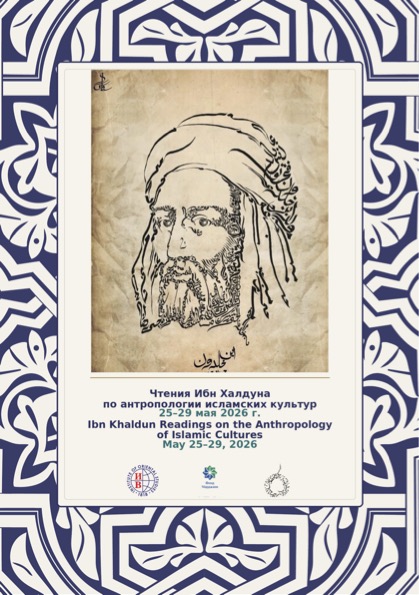
On May 25-29, 2026, the Institute of Oriental Studies RAS held Ibn Khaldun Readings on the Anthropology of Islamic Cultures – the first specialized forum that attracted anthropologists, historians and Oriental Studies scholars from Russia, Germany, France, United Kingdom, Japan, Austria, Uzbekistan and Kazakhstan. Over five days, more than 90 papers were presented at the preliminary session and 4 thematic sections. The conference was organized by the Department of Anthropology of the East in collaboration with the Sheikh Zayed Center for Islamic Manuscripts, Center of Arab and Islamic Studies, and Central Eurasia Research Center, supported by the Mardjani Foundation.
At the opening of the conference, the participants were greeted by IOS RAS Director Prof. Alikber Alikberov, RAS Correspondent Member and IOS RAS Deputy Director Prof. Dmitry Bondarenko, and Deputy Director of the State Museum of Oriental Art Prof. Ilya Zaytsev. Director General of the State Museum of Oriental Art Alexander Sedov and President of the Mardjani Foundation Rustam Suleimanov also sent their greetings. Every speaker emphasized that the name of Ibn Khaldun in the conference’s name is not an accidental choice: his main conceptual work “Muqaddimah”, or “Introduction to History” remains one of a few pre-Modern and non-European texts proposing a systematic theory of sociality, and its potential for Islamic anthropology studies is still underrated.
The conference consisted of a preliminary session “Islam in the post-Soviet anthropological fields” (May 25-26) and four sections:
- Political anthropology of Islam, social processes, practices and institutions in Islamic cultures
- Anthropology of Islamic literacy
- Historical anthropology of Muslim communities in the Russian Empire and USSR
- Historiography and material culture of the Islamic world
The conference proved that anthropological approach to the studies of Islam is going through a period of intensive conceptual renewal. Criticism of categories inherited from the past, such as “post-Soviet”, “traditional”, “radical” and search for methodological languages able to describe Islamic practices in their actual complexity, not reducing them to ideological patterns and culturological cliches, became a recurring theme. The wide array of represented countries demonstrated that Russian Islamic Studies are an integral part of the global academic dialog. In conclusion, the participants unanimously approved to meet regularly.
Organizers express particular gratitude to Dilyara Galimova, the author of all included photos.